Hoke's Games was created in 2013 to publish the board game Emperor's New Clothes through a Kickstarter campaign. Although the funding drive is now over, this site is an archive of the campaign itself and will also be a place to share variant rules, photos and videos of gameplay, and future Hoke's Games releases.
I've copied over the Kickstarter campaign posts and updates—that way it's a little easier to read through the Kickstarter campaign in the order it was published. All of those posts will be back-dated so that they appear on the date they were posted to Kickstarter. If you'd like to follow along with the story from the beginning, simply start from the first post and then click the "Newer Post" link at the bottom of the page (on the left).
By the end of the campaign, the front page of the Kickstarter page had a list of all of the artists named in all of the updates, as well as several links to other sites that had written about it.
Here's a list of what appeared on the home page:
"Anything that challenges my imagination and encourages creativity is going to score big points for me." - Jason Tagmire, Fruitless Pursuits
"Though the pieces might make you think it’s a ruse…it’s actually far from it." -- Cathe Post, GeekMom
This gets a big thumbs-up from me, too. Often games with this many
mechanisms don’t do any of them particularly well, but they’ve managed
to combine everything into a nearly perfect whole. Emperor’s New Clothes
should be seen to be believed. -- Firestone, TheologyOfGames
"I think it’s hilarious and I have to applaud them for bringing the narrative of the game to life in such a clever way."
--DMBigfoot, The Inlay
"the naked brilliance of the design is undeniably thought-provoking." -- Matt Blum of GeekDad
"There are many Kickstarter projects that seem too good to be true,
and that’s mostly because they are–but we spend money on them anyway."
-- Byron Campell of NerdSpan
"I find the project highly transparent, especially with the
availability of the print and play version, which both allows you to
check that you can see ROOS and to make sure that the game is to your
liking." -- Greg, 3DTotal Games
"I must admit however that this campaign is probably the most unusual I’ve ever seen." -- Dad's Gaming Addiction
Plus there was this video review from UndeadViking, which I mentioned in Update #22:
This is where I'll collect rule sets for Emperor's New Clothes. Right now I've got the "official" rules for my version of Emperor's New Clothes, as well as rules for The Boy Who Cried Wolf, which can be played using the components you'll have in ENC.
Here's a video that explains a little more about how to play the game.
If time permits, I'll try to make a fancier version of the rules with diagrams, and I'll update this post. Also, if you come up with other games to play with your components that you'd like to share, I'd love to post them here as well. Either email me directly (jonathan [at] geekdad [dot] com), or post them to the BoardGameGeek files section and send me a link!
You can also see variants on the BoardGameGeek page, although some of these are ROOS-enabled and you may not actually be able to read them.
Note to backers: I noticed there is an error on the printed "Roles Summary" card included in the game. For the Farmer, it says to discard all gullibility and dignity, and then "score 1 point per ___." The blank should have a gold coin icon there.
Note: This is a copy of Update #33 from my Kickstarter campaign.
This may be the
most colorful photo we've ever posted of Emperor's New Clothes. Game
Salute said they're still waiting on the actual boxes—apparently those
have taken the longest—but they do have most everything else: the ROOS
bits and the TROO bits, cards, tuckboxes, dice, boards, tiles, sand
timers… Some of these components only come in the larger sets, so
depending on which version you backed you'll be getting some combination
of these. (And, of course, each copy of the game comes with the
invisible fleece, which is up at the top of the photo.)
And here's a closer look at the sticker sheet: all backers at
the $5 and up level get one of these, even if you didn't get the game
itself. The three logo stickers are for the front and sides of the box
(if you want your box to have a logo) or, you know, you could put it on
your bumper. The dice stickers are there in case you want to use real,
visible numbers for the dice-rolling, but I encourage you to try it out
without them at least once. There are also some wolf and sheep stickers
that can be used to play The Boy Who Cried Wolf. Oh, and that sticker in
the lower left is for you to write the age, number of players, and game
length to put on the box—if you're designing your own game you can
customize it to your liking!
A Story from XOXO Fest
While
I know a story is a poor substitute for having the actual game in your
hands, I hope it's at least an appropriate continuation of the campaign.
At the end of September, I had the chance to participate in XOXO Fest's
tabletop night. I took my prototype of Emperor's New Clothes, hoping I
could persuade a few people to try it out despite the presence of other
crowd-pleasers like Cards Against Humanity, Werewolf, Dungeon Roll,
Story War, Relic Expedition, and Machine of Death. But I grabbed a
table, set out my blank white components, and waited for somebody to
take the bait.
Since I had a limited amount of time, I gave a very brief
overview of the Kickstarter campaign to those who weren't familiar with
it, telling them about the ROOS but then skipping to the explanation so
we could sit down and play. Many people were quite open to the idea, and
even if they didn't quite get what was going on at first, eventually
they got the hang of it and were coming up with fun action cards on
their own. I explained that the rules I use provide a structure within
which you're free to improvise, but if you use my complete rules there
are limits on what you can make up. The dice have specific possible
faces; the role cards have pre-determined scoring rules; the resource
cubes represent three specific things. However, you only have to use as
much of my rule set as you need in order to improvise a game. If the
group agrees to use fewer of my rules in order to allow for more rules
of their own creation, that's part of the idea.
One of the people
who was really excited about the idea of a completely improvised game
was Sandy Weisz. He said he wanted to come back later and try that, and I
said he would be welcome. In the meantime, I played two rounds with
various festival attendees (including Henry Smith, the designer of
Spaceteam!). When the second game concluded, I left to go to the
bathroom, and came back to find this:
Sandy (standing) had gathered a group of eight players to try
the "pure improv" mode. The explanation he gave was that the only rule
of the game was that all the rules had to be consistent with each other.
They then proceeded to play an elaborate game that involved traveling
between locations using bizarre vehicles, all made up on the spot, and
the game lasted about an hour. Sandy said that he and Martin McClellan
(the guy in the hat) are actually considering developing their idea into
a game.
When that game wrapped up, a group of spectators
approached and asked what was going on. Sandy spoke up, giving them his
one rule: make up a game and keep all the rules consistent. Then they
sat down and played a completely different game.
This one was a party game of some sort—they played cards and
rolled dice, but every so often everyone had to touch their noses or the
table, or both. (By the way, that's Chris Darden in the background
playing Dungeon Roll.) And then when they were done, a third group came
over and made up yet another game.
I'd had the idea that a set of
blank components could inspire creative play, but this was really the
first time I saw it in action, with so many people collaborating on
impromptu game design. This is what I hope happens when you finally get
your own copy: that it leads to these unpredictable, delightful
experiences.
I love the idea of Daniel Solis' blog. Among other things, he often posts game ideas that he's come up with, whether he's designing a game based on it or not. It's also a different approach to what you do with game ideas: rather than trying to keep them secret, he just posts them on the internet where anyone can see them, and if you can use a mechanic, great.
I've found that I simply don't have room in my life at the moment to spend a lot of time prototyping and playtesting games. Any time I have for playing games is usually devoted to games I need to play for review, and with the massive growth of Kickstarter board game publishing, chances are that I've got some prototype or demo copy that somebody has sent me and I've only got a few weeks to try it and write it up.
I've got a notebook where I jot down some ideas, but I thought maybe a blog would work just as well, and possibly even get me some feedback. Or provide somebody else with ideas they can use.
So today's idea is about poor decision-making. I've actually got some ideas about a game based on being a dad, where the kids run around the house trying to accomplish their own goals while not setting off dad's rage meter. You know, edutainment. I won't get into those details here, but I was thinking about the fact that when people (and kids especially) are tired or hungry they start to lose their ability to make rational decisions. How could you model this in a game?
Well, my game included the ability to pick from a set of actions, things you could do while interacting with the other kids: ask politely, yell, grab, hit, trade, tattle. I thought maybe these could be arranged in a way such that if your hungry/tired meter is high, then you start losing cards. First to go is "ask politely," of course, but then I could either arrange the rest in some sort of order or else say that you just lose one at random. Pretty soon, if you still haven't eaten or taken a nap, your decisions are completely random.
I wonder if there are any games out there that model this sort of impaired reasoning capacity and, if so, how it's done.
Note: This is a copy of Update #31 from my Kickstarter campaign. There were a few updates between #27 and this one that basically stated things were delayed and still in process.
Making the Rounds: Gen Con, PAX, and XOXO Fest
Well, while we're all waiting for production and shipping news, I thought I'd share a few stories about teaching Emperor's New Clothes and a little more of the ideas behind it.
I was fortunate enough to go to Gen Con and PAX Prime last month, where I
was able to meet a lot of people in person, play a bunch of great
games, and have some really fun conversations. While I'd been hoping
that I'd have a finished copy of Emperor's New Clothes to take to
these shows, that didn't happen, so I took my prototype copy with me
and managed to play a few times when I wasn't walking around gawking at
all the other shiny stuff everywhere.
Whether people had seen the Kickstarter or not, they did tend to
give me skeptical looks when I first got out my pile of blank cards and
dice and pile of white cubes. However, once we started playing, most of
the folks I taught ended up enjoying the game. I love introducing new
players to the game because it's particularly fun to see the sorts of
cards they'll make up as they play them, and how they manage the memory
portions of the game. But I also really love the conversations that
I have after playing the game. My hope was to get people thinking about
game design and play, and that definitely happens.
The box itself will come with a blank "rulebook"—stapled glossy
paper that fits in with the whole ROOS story, and a prop you can use
when you want to be a rules lawyer during play. However, I've also got
my version of the rules listed on my website. Right now you'll find rules for two games: Emperor's New Clothes and The Boy Who Cried Wolf
(which requires three marked dice). I plan to add other rule sets here
as backers submit them, so that you can see what other people are doing
with their game sets.
My goal with the rules is to provide just enough structure for
people to play a game. If you choose, you can just take the box of
components, sans rules, and come up with whatever you want with your
fellow gamers. Or, if you need a nudge in some direction, you can start
with my basic order of play: Draft Roles, Roll Dice, Reveal Roles, Score
Points. Still not enough? Then follow my instructions for what
specifically is on each die, what the three types of resources are, and
the list of roles. And if you want even more, I've given detailed
scoring rules for each of the 14 roles included, assuming you want to
use my list. The only thing I haven't spelled out is the action cards,
although I've given a few examples of cards you could play.
What I've found is that when I'm teaching the game I generally set
the types of resources, what's on each die, and a few of the roles.
However, I've had some friends teach the game with even less spelled
out: in those games there have been people playing the Professor or the
Doppelganger. Sometimes the resources include fabric, or wood, or food,
rather than my list of gold, dignity, and gullibility. Sometimes there
are more than three types of resources.
What happens over the course of play is that the actions that
players take and the things they make up set precedents for the rest of
the game. Whoever's first to move their scoring marker on the (blank)
scoring track determines things like where the track starts and how far
apart the spaces are. If somebody rolls a 5 on a die because I haven't
explained that they have only 1s and 2s, then from now on that die has a
5 on it—and necessarily has one fewer of something else. Each player's
decisions collapses the possibility tree a little more, until by the end
of the game nearly everything has been defined.
This is particularly true of the role selection. Although at the
start you pass around cards and pretend to choose roles by each taking a
card, the real role selection happens later. When the first player
announces that she's the Emperor, suddenly it means that all of the
other players (who may have thought they were the Emperor) must choose a
different role on the spot. For me, this is where a lot of the real
strategy in the game appears: how do you select a role that maximizes
your score and minimizes somebody else's, based on the resources
everyone gathered before they actually knew what roles they were?
At both Gen Con and PAX I also played a few rounds of The Boy Who Cried Wolf. This is a bluffing game along the lines of Liar's Dice,
in which you take turns being the Boy, trying to trick the other
shepherds. The (visible) dice determine whether or not a wolf comes, but
you don't reveal until the other players have decided whether to come
to your aid. Guess wrong, and you'll lose sheep. Guess correctly, and
your sheep are safe—and you might even gain sheep as a reward. I've
still been tweaking the rules a little based on playing with different
numbers of players, but it's a quick game that I've really enjoyed
playing as well.
One last thing: If you happen to be attending XOXO Fest this coming weekend, come see me at the Tabletop event on Saturday evening. I'll be there to demo and talk about Emperor's New Clothes for a few hours alongside other game designers with their games and prototypes. You can see the full lineup here.
I'll be there toward the beginning of the evening starting around 7pm, but parenting duties prevent me from staying until 1am!
This is a copy of Update #27 from the Kickstarter campaign.
Update from Jonathan Liu, Designer
Hello, Backers!
Right
now I'm waiting for Game Salute to get the initial survey together, but
I thought you might want a little update. So here's a peek at the
stickers for the dice, plus a lost Designer Diary entry that got missed
during the last week.
In the preliminary survey, you'll be able to
tell us whether you had any add-ons, whether you want the white (ROOS)
bits or the colored (TROO) bits, what size T-shirt, and that sort of
thing. You'll have one more chance for more add-ons or additional copies
of the game at this point. (As a reminder, the Create-a-Game Kit will
be available from Game Salute later but it won't include the sticker
sheet and items may vary slightly; the Emperor's New Clothes version is
available exclusively through the Kickstarter campaign and won't be sold
in stores afterward.)
Dice stickers!
So, here's a look at the designs for the dice stickers:
These icons were designed by Heiko Günther, one of the designers interviewed in Update #12.
The green fig leaf is for Dignity, the red jester hat is Gullibility,
and the gold coin is Gold. The Wolf and Sheep icons are for the other
mini-game, The Boy Who Cried Wolf. (The actual dice are less rounded
than the rendering here, but you get the idea.)
As explained
before, the stickers for Emperor's New Clothes are optional—I prefer
playing with the blank dice, but I really love these icons, too. Since
we decided to use color on the stickers, the TROO-bits option will come
with colors to match these: green, red, and yellow (rather than white,
black, and yellow).
To play The Boy Who Cried Wolf, you will need
to use at least 3 dice for wolves; the Sheep die could be optional
because I've got some variant rules in which you will bid the number of
sheep at risk, but I'll get to that later. The game could also be played
with standard six-sided dice, since the Swindler-level compact game
includes 4 dice and you'd have to decide between stickering the dice for
Emperor's New Clothes or The Boy Who Cried Wolf.
NOTE: The
Designer Diary entry below was actually written up for the last week of
the Kickstarter campaign and was supposed to be posted with Update #20,
but between PAX East and the camping trip we had some dropped signals
and it never got posted… and I didn't even realize it until just last
week. So, of course, this is a pre-reveal update but it still
communicates my feelings about expectations and execution.
Designer Diary: Great Expectations (or, Executing the Emperor)
I
have a good friend who was sick for a long time and was unable to
travel or have much face-to-face interaction. So he started what he
called his Hypothetical Birthday Party, where he emailed friends from
near and far, asking them to attend his party by writing descriptions
and sending photos of what they would bring to his party. Being
hypothetical, you could bring anything you wanted, no matter how
difficult to prepare or impossible to procure. Although these parties
weren't "real" in the sense that you couldn't physically partake of all
of the fantastic dishes and drinks contributed by all the party-goers,
they've become a tradition that many of us look forward to. My friend
was able to have a non-hypothetical birthday party this year, but he
still held the hypothetical one too, and it was well-attended. The
question that arose is whether the real could possibly live up to the
imagined.
Whether it's a birthday party or board game or book or
movie, there can be a difference between your expectations and the
reality. In some cases the reality ends up exceeding expectations, which
is always awesome. However, when you're making something, particularly
something creative, there's almost always a gap: the reality falls short
of your expectations.
Why is that?
Well, to put it simply:
you can imagine perfection, but that's pretty dang hard to achieve. It's
why people are so often disappointed in the movie after they've read
the book and already pictured what everything and everyone looks like.
It's why video game graphics, no matter how powerful consoles get, will
never beat the resolution of a text adventure game.
Years ago I
read a book called Art and Fear: Observations on the Perils (and
Rewards) of Artmaking by David Bayles and Ted Orland. It's about
creating art, mostly in the traditional sense, but I think the lessons
apply to nearly any creative process. The book talks about this gap
between ideas and execution, and argues that not only does the gap
exist, but that it SHOULD. Because if everything you make turns out
exactly the way you imagined it, then you're limiting your imagination
to what you know you are already capable of. Artists and creators should
be pushing the limits of what they can do. We should be testing
boundaries, trying new things, taking risks. That's how you grow. And
it's also how you make "mistakes" that actually lead you in new,
exciting directions.
Here are just a few quotes from the book that really stuck with me:
Making
art provides uncomfortably accurate feedback about the gap that
inevitably exists between what you intended to do, and what you did.
Art is like beginning a sentence before you know its ending.
People
who need certainly in their lives are less likely to make art that is
risky, subversive, complicated, iffy, suggestive or spontaneous. What's
really needed is nothing more than a broad sense of what you are looking
for, some strategy of how to find it, and an overriding willingness to
embrace mistakes and surprises along the way.
That
moment of completion is also, inevitably, a moment of loss—the loss of
all the other forms the imagined piece might have taken. The irony here
is that the piece you make is always one step removed from what you
imagined, or what else you can imagine, or what you're right on the edge
of being able to imagine.
So that leads me back around to
executing my Kickstarter project. When I first started working on
Emperor's New Clothes, I had a vision of what it would look like, how it
would play, even how the Kickstarter campaign itself would look. I
thought about the cards, the logo, the cover art, the gameplay, the
story.
Parts of it turned out the way I imagined, other parts fell
short, and still others surprised me. Of course, Emperor's New Clothes
is not a singular vision: I started the ball rolling, but to make it a
reality I needed to share my vision with all of the other people
involved: the artists and designers and folks at Game Salute. But
everyone pictures things a little differently—what I see in my head may
not be exactly what you see. Until we all become telepathic, there will
always be something lost in translation—but that also means that each
person brings their own unique vision to the project and that can lead
to very cool results.
And last but not least—arguably MOST
important—is YOU! What is art if it is not observed? What is a game if
it isn't played? What is a Kickstarter project without backers? By
backing the project and giving feedback and arguing about it on Twitter
and BoardGameGeek, all of you have shaped Emperor's New Clothes as well.
It isn't something that popped fully formed out of my head, but
something that has evolved and shifted thanks to you. Whatever the end
result of the Kickstarter campaign itself, I'm grateful for that. It's
been terrific (and terrifying) to see my idea take shape this month.
It's
hard for me to know whether Emperor's New Clothes, in the end, will
live up to your expectations. With so many different people, everyone
has a slightly different vision of how things should turn out. No matter
what I reveal at the end of this week, I expect that some of you will
be delighted and some of you will be disappointed. But I hope you'll
love it. I hope that you will be as excited about and as proud of
Emperor's New Clothes as I am, because I think you and I have created
something pretty magical together.
Note: This is a copy of Update #26 from my Kickstarter campaign. The campaign closed at 9pm PST April 1, with a final count of 280 backers and $6,330 in funding.
THANK YOU!
We did it! Despite the big drop in pledges over
the weekend after my "Pulling Back the Curtain" update, we still managed
to regain a few backers and pledges toward the end, and Emperor's New
Clothes will be a reality. I think it's a fitting birthday present for
the man who provided the inspiration: Hans Christian Andersen. He turns
208 today, and his birthday is also celebrated as International
Children's Book Day, so take a moment today to read some stories to your
children—or to your inner child!
So what's next?
I'll
be sorting out a few details with Game Salute in the next couple of
weeks and you'll get a survey asking for your shipping address. This is
also where you'll be able to tell us what add-ons you pledged for, if
any, and whether you want the ROOS (white) bits or TROO (colored) bits.
Since
I'm unable to post updates directly to the Kickstarter page, you won't
be hearing from me regularly after this, aside from short updates about
production and shipping (which may come from Game Salute). To keep up
with the latest news about Hoke's Games, follow me on Twitter (www.twitter.com/hokesgames) or Facebook (www.facebook.com/HokesGames).
I do hope that as you receive your copies of the game, you'll share
photos, videos, and stories of yourselves playing Emperor's New Clothes.
Plus, I would love to see what new games you come up, and I will try to
have something set up in order to submit your rules so that other
people can try them out.
It's truly been a fantastic experience
and I'm incredibly thrilled for all of you who stuck it out to the end.
But, of course, it's just the beginning!
Jonathan H. Liu
Swindler, Emperor, and Child
Photo: HCA statue in New York City's Central Park by Dismas, used under Creative Commons license.
Note: This is a copy of Update #25 from my Kickstarter campaign.
Happy April Fool's Day
Sorry, I just realized that many of
you were waiting for something funny on April Fool's Day and then I went
and posted a serious update. So, rather than bombarding you with a list
of online April Fool's jokes, I'll just show you one that I think is
particularly pertinent for Kickstarter board game fans: BoardGameGeek.com
has transformed itself into GeekStarter today, a place where you can
pledge GeekGold to support projects. There are a lot of meta projects,
including one to change GeekStarter back to BoardGameGeek.
Not to be outdone, I figured I'd better launch my own GeekStarter project page as well. If it succeeds, I'll retroactively go back in time and launch a Kickstarter campaign for Emperor's New Clothes.
Reddit AMA
I
figured today is as appropriate a day as any to run a Reddit AMA (Ask
Me Anything) for a project like mine. I'll be taking and answering
questions for a couple of hours, so if you want some honest, sincere
answers about the project, now's the time to do it!
Here's the link to the Reddit AMA. I'll check in periodically for the next couple of hours, until about 2pm Pacific Time. Ask Me Anything!
Note: This is a copy of Update #22 from my Kickstarter campaign.
The Last Hurrah Every board game (or any other creation, for that matter) begins with this: something that nobody else can see. It's a vision that exists solely in the mind, and part of the goal of creating is transmitting that vision to other people, getting it out of your head and into the heads of others. Whether that's through pictures or words or actions or some sort of physical object or a melody, that last step of the process is always the hardest.
You can draw and paint and design and write and think about your project by yourself, but at some point art of any sort is meant to be observed. A game isn't a game until somebody plays it. The magic of a book really takes place when somebody reads it. But handing over control—giving other people a choice about what to do with what you've created—is always a scary thing.
Emperor's New Clothes began with this vision: a box of blank white cards and boards and wooden bits, and people sitting around playing it. I had seen pictures of printer's proofs from other Kickstarter projects. I'd also been to a few game day events where I'd wander around, looking at what other people were playing, trying to decide what I wanted to try. I imagined a game that invited scrutiny, one that made people wonder "What is that?"
I imagined a game that didn't just include a small group of people playing it, but one that drew in even more people and engaged them. Even as somebody who is very comfortable playing any type of board game, I'm not always comfortable approaching a game in progress to ask about it. Most gamers don't intend to shut other people out while they're playing a game, but we can unintentionally give off a "don't bother me right now" vibe when we're really engaged in a game. I wondered if there could be a game that encouraged people to approach players, one that started conversations instead of shutting them out.
That was the initial spark of my idea. Sure, it was a bit half-baked. The game as it is now isn't entirely the same thing as it was when I first approached Game Salute, or when I wrote a letter to send out to reviewers and blogs, or when I asked artists if they wanted to sign onto a crazy project. Once I made it public, it was no longer solely my creation: other people introduced ideas and added to it. Some things I liked, and some I didn't, but it wasn't entirely within my control anymore.
If I were to do it all over again, I'd still run the campaign. I probably would have picked a better time to do it. I'd write all my updates ahead of time, and not run it when I had a camping trip planned in the middle of it or at the same time as a major shift for GeekDad. I would have thought more about the fact that people would be dropping into the project on day 1, and day 5, and day 17—that not everyone was following the same threads at the same time. I would have spent more time playing the game with people and less time talking about playing the game.
I won't know until the end of the day whether enough people stick around for the big finale. I won't pretend that I'm not disappointed if we drop below funding, but in the end, I'm proud of what we've accomplished together. We made something out of nothing this month.
At the end of this month, my wife and I will be welcoming our third child to the world. It has nothing to do with Emperor's New Clothes, and everything to do with it. I know that at the end of the month my world will be filled with smiles and cooing and dirty diapers and rocking. Things like Kickstarter and writing for GeekDad just won't matter as much at that point. I wanted to wrap up this project on April 1 not just for the significance of the date, but so that I'd be done with some time to spare.
Whatever else you get out of this Kickstarter campaign, whether you're a backer or you're just here for the schadenfreude, this is what I hope stays with you: You can see things that nobody else can see … yet. Figure out what they are, and then share them with the rest of us*. You never know what might happen.
*Including Game Salute: Dan Yarrington has said he'd love to see game submissions made using the Create Your Own Game Kit.
Note: This is a copy of Update #22 from my Kickstarter campaign.
Stretch Goals Update
As you've probably noticed, we lost backers after my announcement yesterday. For those of you still along for the ride, I had one specific announcement about the stretch goals involved. All of the role cards will remain unlocked: the Jester, Mother, Imperial Court, Townsfolk, and the bonus Troll (in the Kickstarter-themed version) are all explained in the rules posted yesterday. Of course, there is no artwork associated with them but you can use those when playing. In addition, the Pixel Lincoln themed version and the Kickstarter themed version are both "included" as well; just change the theme while you're playing while using the same mechanics and rules. The number of cards and components has already been updated in the Pledge Levels section on the home page to show specifically what you get in each package.
The more tangible stretch goals, the "TROO-bits" colored wooden pieces, and the PennyGems add-ons, we'll go ahead and unlock. The TROO-bits will just be an option you can select when the backer surveys are sent out. The PennyGems are an add-on ($20 per sheet in USA, $25 per sheet everywhere else), and the T-shirts are also an add-on. The one remaining stretch goal, Double The Fun, is still set at 500 backers at the $25 level or higher because that's really the point at which we can move to bulk ordering. "What's the use of stories that aren't even true?" - Haroun and the Sea of Stories, Salman Rushdie
I did see this question on BoardGameGeek that I thought was worth addressing: With all of this "pretending" to play a game, why bother using real cards and dice and bits at all? Why not just sit at an empty table and pretend to play a game?
That's a great question, actually. The answer is that physical objects help us make believe. When my kids are playing with a stick, it's no longer just a stick: it's a sword, or an oar, or a magic staff, or whatever. Why can't they just pretend to have a staff without actually holding a stick? Well, they could, but the physical stick facilitates the imaginative play. You could play Emperor's New Clothes with no physical objects whatsoever, but it means that you're relying entirely on memory for every part of the game, rather than just select parts of the game. The physical cards help you keep track of how many cards you've played, how many dice you're rolling, how many of each resource cube you have. Certainly, there is still a great deal of memory and improvisation involved, but with actual physical pieces there is a little bit less.
The other piece of make believe is the way that abstractions allow for broader interpretation. A stick can be just about anything stick-shaped. But once you start getting a more defined object, like a baseball bat or a plastic sword, it's harder to imagine that as something else. And once you get extremely specific—a replica of Harry Potter's wand, for instance—then it is no longer a generic stick that can be just about anything, and becomes very much one specific thing. That's great if you're playing as Harry Potter, but not as great if you want to pretend you have a crowbar or a dagger.
One of the things I wanted to explore was the suspension of disbelief. Kids are generally much better at this. They're ready to believe things, to see things that we (as adults) can no longer see. When I sat down to play Emperor's New Clothes with my kids, they're ready to go and have no trouble with it at all; it's usually the adults that need the explanation of how to make believe. This is what I've been told by other folks who have tried it out with adults and kids.
When you play a game, you're already suspending disbelief to some extent. I wanted to see how far I could push that and still play a game. For me, getting to a set of blank white components still works as a game, but removing the components altogether is a step too far. (Plus, hey, it's fun to roll real dice, even when they're entirely blank.) Apparently, from the number of pledges that we lost yesterday, the set of blank components is already a step too far for some.
Note: This is a copy of Update #22 from my Kickstarter campaign.
[Spoiler Alert]
Please note: If you're new to this
Kickstarter project and you would like the full experience, it's best if
you go back, read the front page, and then read the Updates starting
from the beginning. However, if you just can't stand all that
blathering, this announcement will tell you explicitly what Emperor's New Clothes is and isn't.
Peeling Back the Curtain
A
wise man once said: "You can please some of the people all of the time;
you can please all of the people some of the time; but you can never
please all of the people all of the time." Oh, wait: it's actually
"fool," not "please." I'd always heard this attributed to P.T. Barnum,
the great deceiver, but it turns out that it may in fact have been
Honest Abe. (Not the Pixel version.)
Still, my version holds true,
too: no matter what I say today, I doubt it will please everyone. But,
like I've said from the beginning, my project isn't for everyone, and I
don't mean that in an elitist, "this game is too good for you" sort of
way, "real gamer" remarks notwithstanding. I mean that in a humble,
realistic, "how could I possibly make a game that pleases everyone?"
sort of way.
Now that I'm actually pulling back the curtain, it's a
bit like pulling off a bandage. I'm tempted to peel it off a tiny bit
at a time, but I know it's probably best (and least painful) to just
give it a hard yank. But that's the thing: I love anticipation.
Sometimes the anticipation of something is the best part of the
experience, that delightful in-between moment when you know something's
coming but you don't quite know what it is yet. In today's world of
instant-everything, it's hard to get that sort of delayed gratification
anymore. Kickstarter might be one of the best sources of it, in fact:
you pay money and then wait for the results, unlike ordering something
online with free two-day shipping. You have months to anticipate what's
coming, to talk about it, to look forward to your purchase—it puts off
the buyer's remorse that nearly inevitably comes after you actually
receive something and add it to your collection.
All right, enough stalling.
First, what Emperor's New Clothes is NOT:
a joke Kickstarter project.
a scam.
The funding goal was set at an attainable value that will
actually make feasible the delivery of a product. We will charge credit
cards (if it funds). We will not be canceling this before it ends. We
will deliver a physical, tangible product. We aren't taking the money
and running.
Yes, there are a lot of jokes scattered throughout
the project. They were meant to be obvious, the sort of thing that
nobody would actually fall for. The ROOS ruse, Wysiayg ("What You See Is
All You Get") Press, Hoke's Games hoax. I'm surprised nobody called me
out for pledging to "kick back" with my profits or argued that John
Kovalic isn't actually a muskrat. There is, sadly, no intangible
invisible fleece—you wouldn't be able to find it once you set it down
anyway.
But those jokes were meant to be the equivalent of jokes
told during a lecture to loosen up the audience, rather than the main
point. While some of you have been arguing for a month about whether or
not showing a photo of white components is funny, I've been trying to
have a (mostly) sincere discussion about the nature of play and
imagination and games.
Now, what Emperor's New Clothes IS:
a set of blank components (in white or color).
a Create Your Own Game Kit.
a meta game about a game in the form of a Kickstarter campaign (which you've already played).
a game you can actually play.
It was also a social experiment about Kickstarter, a collection
of essays about game design, a trial-run for me in running a Kickstarter
campaign and working with Game Salute, and a lesson for me in
unintended consequences.
First, the set of components: The
components (cards, board, wooden bits, dice, box) are all real, but
unprinted. You can see the current set of all the components on the main
Kickstarter page, under the "Pledge Levels" section. We've updated
those to include everything that is currently included.
There WILL be a printed sticker sheet in the box with the Emperor's New Clothes
logo, so that you can decide whether you want to stick it on the box or
keep the box blank, or use the box for whatever else you're doing. The
sticker sheet may also include smaller logos for Hoke's Games, Game
Salute, a "player number/play time/recommended age" sticker, and
potentially some custom stickers to play my included mini-game, which
I'll tell you about tomorrow. The optional PennyGems are real, though of
course they are white. The optional T-shirt is real, too, and it is
white with the Hoke's Games logo on the back. And the "Double Your Fun"
goal is completely real: if we hit 500 backers at the $25 or higher
level, we WILL double the pertinent components, making it a much better
value for your dollar.
There is, as you have surely figured out by
now, no such thing as Regulated Optical Operator Screenprinting. Mac
Barnett (from the Wysiayg Press video) is in fact Mac Barnett,
children's book author. Will Whedon from the American Association for
the Advancement and Understanding of Gaming Humor (AAAUGH) is in fact
Scott Brown who writes for Stage Dive on Vulture.com. John Kovalic is not actually a muskrat.
So why go to all this trouble to sell you a box of blank bits? Isn't this just a prank gift?
Well,
sure, if you want to use this as a prank gift, you could do that. It'll
last about as long as it took you to watch my Kickstarter pitch video
and then scroll down to see the photos of the game. "Ha ha, Emperor's New Clothes,
I get it." Or if you want to take it out and play a prank on some
friends, pretending to play a game while others look on and try to
figure out what's going on—that is another way to play it, a cooperative
game in which the folks at the table are all acting as the Swindlers,
and everyone else looking on ends up playing the Emperor or the Child.
But we've already played that game, too: in the form of this very
Kickstarter campaign.
For some people, the Create Your Own Game
Kit is where the value lies. That's really where Game Salute's
involvement comes in, because they're starting up a GameBits line of
components. You can buy them piecemeal or in pre-packaged boxes, and the
idea is that if you're a game designer this is just one more source of
quality game components to use for prototyping. I'll admit that one of
the inspirations for this project came from seeing all those production
proofs from other Kickstarter projects, where they get a box of white
components to see what the final quality of all the bits and cards and
boards is. The first time I saw a photo of one of those, I really wanted
one for myself. I figured maybe other people might want one as well.
How many? I didn't know. That's what Kickstarter is for.
As far as
Game Salute was concerned, this was a much more interesting way to
launch this product line; for me, it meant that I didn't have to figure
out how to set prices and deliver a hundred boxes out of my living room.
But I would wager that the number of people who are actively designing
games but don't have a source of prototyping components isn't that big.
That's sort of a niche product.
That's where the real game comes in.
Part of the idea of Emperor's New Clothes
is emergent behavior that arises from a few simple rules. Carcassonne,
for instance, has a fairly small rule set (in the base game) but it can
lead to a lot of deep strategies. By providing a basic structure (pick
roles, roll dice, collect resources, get points) I allowed for a number
of different behaviors. But on top of the rules of this "game" there is
another layer of meta-rules: you pretend you can see what's going on.
You can be a rules lawyer, but you don't say "that card doesn't say
that." The theme is Emperor's New Clothes, so you're not going to
play a card that involves sports cars or the zombies or Rick Astley.
Things have to feel like they fit. Sure, in a game where the cards are
blank, you could play a card and say "This card says I automatically
win." But while that may win the "game," this is in fact a game that is
more about the playing than the winning.
But even as I
demonstrated the game, describing various characters and what they would
do in the game, a game began to form. It was emergent behavior of a
different sort: the way that people responded to the campaign affected
the way I was running the campaign. By the time I went to PAX East to
run demos of my game, I actually had a much more fully fleshed game—in
my head, at least. When I taught the game, I knew what the three
resources types were, what the dice looked like, what each of the 12
characters did and how they interacted with each other and scored
points. I knew a good number of action/event cards, and the board itself
was basically a simple scoring track. By explaining the game and
playing it, I helped other players "see" what was on the cards and the
board.
You'll get a blank glossy "rulebook" to use as part of the
game, but I've also written out the rules I've been using, which you can
download now as a PDF.
Some people will be able to take the set of components and just run
with it. Others will want a little structure, and some will want a lot.
Here you can see you what I have (basic turn order, all 13 roles and
their descriptions, etc.) and you can actually play it. You can decide
if you want to write it out on the cards, or play with them blank. Or
use a little bit of the structure I provide and throw away the rest.
Just take a look at the Undead Viking video review.
We sent Lance a box of components with just a vague description of the
game and its theme. That whole description with the Emperor moving on a
track, and different types of townspeople, and the real-time
lightning-round with the sand timer … that all came entirely from
Lance's head, and it's brilliant! I want to codify it and play it and
see if it works! (The Deluxe version will come with a sand-timer and
I'll see if we can be sure to have some meeples so that you can play
Lance's version.)
What I plan to do eventually is to set up a
place where you can submit your own creations as well. I want to see
videos or read session reports of people playing my version, or Lance's
version, or their own versions. Will every game that everyone makes
actually be fun? Probably not—but we'll have fun making them.
What You See Is All You Get
If
all you choose to see is a bunch of blank components, then that is in
fact "all you get." If you see it as a prank gift to give to your gamer
friend, then that's all you get. But if you choose to see a game, then
you will get a game. In fact, maybe the game that you see is better than
the one that I see. Think about what you "saw" when you first came
across this Kickstarter page and watched the videos and read the
descriptions. Chances are, you "saw" something there. I challenge you to
play that game.
Here's one interesting aspect of playing with
blank cards, though, even with codified rules. When you're doing the
role selection and rolling dice and grabbing resources, that's imaginary
to some extent: nobody can see what you rolled. However, once you've
taken resource cubes from the supply, people can see what you took, even
if they're all white. There's some element of memory, but if you keep
them in separate piles, people can glance over and see what you have.
Then, when roles are revealed, things get pretty interesting. If
somebody claims to be Emperor, then you know that you can't be
Emperor—so you have to pick something else, even if your current set of
resources would be great for the Emperor. Since there are specific
scoring mechanics for each character, it is possible to win or lose at
the game, by choosing the right role at the right time.
On top of
that, though, you could also layer on a meta game in the form of
achievements. I have a short list of achievements (which I will also
release later, for free) that you could include, letting each person
draw a few before the game begins. They might be things like "Have one
die stolen" or "have three cards played on you by other players in one
turn." They'll be things that you cannot control directly, and each time
one of them occurs, you earn points in the meta game. It turns what
started as an exercise in improv into a game of trying to get other
players to perform certain actions within the scope of this game.
Just yesterday I was sent a link to Yoko Ono's "Play It By Trust" white chess set.
It's sort of a high-brow art project, but at the same time it makes
sense to me. I imagine there are chess masters who would be able to play
this because they can hold all of the pieces and ownership in their
head, whether they're white or not. They might even be able to play a
game of chess with no actual pieces on the board whatsoever. But for
people who don't know chess that well, it becomes a game of convincing
the other player: arguing over whether a piece is yours or not before
you can move it. It's no longer just chess, but it is still a game.
As a bonus for International TableTop Day, here's another game that you can play using the components from Emperor's New Clothes. It's called The Boy Who Cried Wolf, and it's a simple dice-rolling bluffing game I co-developed with Darrell Louder. Download the rules for The Boy Who Cried Wolf here. I also have an Emperor's New Clothes
press-your-luck card game, but that wasn't really an essential part of
this campaign and I wasn't sure whether or not to include it. I may
throw that in later.
So why is Emperor's New Clothes worth backing?
Like I said, it's not for everyone. (Really, now, how often have you seen a Kickstarter campaign that tells you that?)
Not
everyone wants a storytelling game or a Create Your Own Game Kit. Most
people browsing Kickstarter tabletop games are looking for a
conventional game, something that has art they can see and an inflexible
rule set. That's what I'm usually looking for myself. But with things
like Superfight! and Story Wars and Machine of Death, clearly there are
people looking for something that involves more imagination and
subjectivity, games with a lot of wiggle room.
Can you get all of
these components yourself? Sure. Except for the stickers and the
T-shirt, everything you see here is available elsewhere. You might even
be able to cobble together your own set by cannibalizing existing games.
With a little legwork, you can probably find all of the components
we're including (or something similar) for a little bit less. However,
if we hit that Double Your Fun stretch goal, then everyone benefits,
because you'd get more components for the money than you could by buying
them yourself. Now we all get to play another game called The
Prisoner's Dilemma: if some people pull out funding and some people
stay, then the people who stay don't get as good a deal and they may
feel like they should've pulled out. But if everyone keeps their funding
in, then it's a better deal for everyone.
But, as I said in my
very first update, what you're buying isn't just a box of components, or
a Create Your Own Game Kit, or even a weird meta game that I think you
might enjoy actually playing. What you're buying is the story. I hope
that I've given you an interesting experience this month, a rare
instance of not being able to simply consult Google or Snopes to find
out if something is real. It hasn't been just a one-man show: you have
participated here in the comments, on BoardGameGeek and Twitter, by
making up your own rules or arguing about whether or not there's
anything there at all. As hokey as it sounds, the Kickstarter campaign
has been a collaborative piece of performance art, one that won't cost
you a dime unless you feel like spending it.
I've spent most of
this month telling you a long story about a fantastic game. The price of
the story is pay-what-you-want: I purposely made all of my updates
public rather than backer-only. If you've enjoyed reading along, I'd
love if you put a tip in the jar. If you liked it enough that you want a
memento of the story, then that's what the physical game is.
It's
a tangible artifact that serves as a souvenir of this tale—and one that
I hope inspires you to play (and invent!) many more games.
Note: This is a copy of Update #21 from my Kickstarter campaign.
Meet the Artists: James Stowe and Jonathan Hill
If you like RPGs and webcomics, have I got a site for you: SidekickQuests.com. James Stowe's online comic features a small band of sidekicks in your typical RPG fantasy world. What's fun is that occasionally there will be little indicators showing what the character "rolled" for a particular skill, which is then translated to how the action plays out in the comic, as in the sample page below:
On top of that, he's also been developing an actual RPG as well! So James has some experience in combining his illustrations and game design, skills that are also useful in a project like Emperor's New Clothes. Although Emperor's New Clothes is designed for older players, James' illustrations make me want to do a kid-friendly version, too. Well, maybe that can be my next project after I recover from this one.
Jonathan Hill is an illustrator and cartoonist. He illustrated Americus (written by MK Reed), which is about a small town and the controversy surrounding a fantasy fiction series. The story in Americus mirrors the real-life controversies around the Harry Potter series. For this graphic novel MK and Jonathan created their own heroine, Apathea Ravenchilde, and when characters read the books, Jonathan's illustrations bring the stories to life.
Although there are only small excerpts of Apathea Ravenchilde within the graphic novel, MK and Jonathan had developed a lot of the characters and settings anyway. So they created a guidebook to the world, making it look something like a D&D manual written as a textbook for adventurers. (I bought a copy. It's fantastic.) What I love about it is the lengths they went to in order to create an artifact from an imaginary world inside their imaginary world.
You can see more of Jonathan's work at his website OneOfTheJohns.com. Kickstarter-themed Version
Yesterday I talked about expectations and execution, and the way Emperor's New Clothes is really a collaborative project, that it has evolved due to your input. So here's another themed version inspired by all of the dialogue surrounding Emperor's New Clothes.
Like the Pixel Lincoln crossover version, this is simply a reskinning of the game, with almost all the same gameplay (and one fun change). But as I've said before, simply changing the theme, without actually changing gameplay, can make a tremendous difference in how a game feels when you play it. It's hard to explain exactly why, but imagine playing Zombie Dice with just regular six-sided dice. You could do it, but it would be too abstract. My kids wouldn't like it, and I bet you'd never have a blockbuster hit.
So for this version of the game, instead of a vain Emperor and clothes nobody could see, the game reflects the Kickstarter campaign itself. You've got two Swindlers, myself and Game Salute, and instead of an outfit it's a board game. The Emperor has been replaced by Backers, and the Child will be played by Ken Grazier of Geek-Craft. (By the way, I did meet Ken in person at PAX East and we bonded over a game of Sentinels of the Multiverse. He presented me with a peace offering of custom buttons, and I gave him a set of ROOS PennyGems.)
Here are the rest of the characters:
Jester = Kyle Scheele of Ridiculo.us
Minister = BoardGameGeek
Knight = Kickstarter
Lady-in-Waiting = Amazon
Seamstress = Game Reviewers
Fisherman = Byron Campbell of NerdSpan
Farmer = Non-Backers
You'll notice there's no Mother in this version, because nobody stopped Ken from posting the spoiler. Instead, we have the Troll: I won't name anyone in particular, but the troll is played by Internet trolls. Here's how he works: anyone who interacts with the Troll in any way (after the roles are revealed) loses 1 dignity, and the Troll scores 1 point for each dignity discarded this way.
You'll notice that this adds some interesting nuances to the game and although it's not a perfect analogy, it's a modern twist on the classic tale.
And what better artist for a Kickstarter-themed version than Adam Rebottaro of Greater Than Games, a company that has had tremendous success on Kickstarter? Adam is, of course, the artist for Sentinels of the Multiverse, a cooperative comic book superhero game which has run several successful campaigns for the base game and expansions. They also have the distinction of being the first project I've backed which delivered the reward before the estimated delivery date.
I met with the GTG guys at PAX last weekend and pitched them on my game,
and although a Sentinels crossover wasn't in the cards, I think having
Adam involved is still a pretty sweet deal.
As with the Pixel Lincoln version, there is no extra cost involved with this version; when you get your backer survey after the campaign closes, simply pick the Kickstarter version option.
Note: This is a copy of Update #19 & 20 from my Kickstarter campaign. Due to an error, the first part got posted but not the second, and Kickstarter doesn't allow you to edit updates after half an hour has passed. So the second part got posted as Update #20.
Meet the Artist: Gene Luen Yang
Gene Luen Yang is a writer
and cartoonist whose comic books often (but not always) deal with Asian
American identity. He's won a couple of Eisner Awards and has both
illustrated his own comics and written comics illustrated by other
artists. Later this year he's publishing a two-part work called Boxers
& Saints which looks at the Boxer Rebellion from both sides: the
protagonists in one book end up being the antagonists in the other. I
thought that was a fascinating way to tell a story, one that offers
multiple perspectives and interpretations of a common experience.
Gene's
illustrations are more stylized and the bold lines and graphic
qualities are almost iconic, which makes them great for a board game.
Gene also has fun putting his own spin on iconic characters, as you can
see from these Chinese opera versions of Captain American and Iron Man.
One
comic that Gene wrote (but didn't illustrate) that really struck a
chord with me was The Eternal Smile, a collection of three
interconnected stories illustrated by Derek Kirk Kim. The third one,
"Urgent Request," is about a young woman named Janet who strikes up a
romance with a Nigerian prince over the internet. While it seems at
first that it's going to be some sort of cautionary tale about internet
scams. Gene manages to make into something so much more, a hearfelt
story about the power of make believe.
For more about Gene, you can visit his website GeneYang.com.
Poll: ROOS and TROO Bits
Hi,
we're getting closer to our "Double Your Fun" stretch goal where we
double the number of most of the components (not the boards, for
instance) in each game. One backer made a good point: he would like to
try Emperor's New Clothes with a wide range of players and asked if,
when the components are doubled, if he could get one set of ROOS bits
and one set of Typical Regulated Operator Optical (TROO), conventionally
colored bits.
I checked in with Game Salute, and it would be
tricky to have a bunch of different options if we hit that Double level,
if some people wanted all ROOS bits and some wanted TROO bits and some
wanted half and half. The easiest solution would be for everyone to get
half and half: in fact, that would mean that you get exactly what you're
pledging for right now, plus a free set of the other type of bits at no
extra cost. But I'm wondering if there are a lot of backers who would
prefer to have all of their bits either conventionally colored or ROOS.
If it seems like a majority of people want all of one type, then we'd go
with just those two options at the end, without a half-and-half option.
The
disadvantage to having half-and-half, of course, is that you still run
into the same issues of running out of resource cubes and having to make
do with other markers, or else mixing up your ROOS and TROO bits. (In
which case you'll probably need to rely on a non-gamer to help you sort
those apart.)
We are also considering offering extra packs of Bits
as an add-on, so you can just increase your pledge and throw in either
ROOS or TROO bits along with the PennyGems and T-shirts. Game Salute
will provide more details about this before the final funding is
complete, but that way even if we don't hit the Double Your Fun goal
you'll still be able to get both types of bits without having to pledge
for two copies of the game.
Speaking of which, if you are
interested in getting multiple copies of the game, this works the same
was as the add-ons. Simply hit the "Manage Your Pledge" button and
increase your pledge amount by whichever version of the game you'd like
to add. For instance, if you're currently backing at THE EMPEROR early
bird level for $70 but you'd like to add on a copy of the compact
version, increase your pledge to $95 ($70 for the deluxe, $25 for the
compact) and leave your reward level selection at THE EMPEROR. If you've
already pledged for at least one copy of the game, we'll honor the
early bird prices for the add-ons even if those early bird slots fill
up.
So, which would you prefer in your box: all the same type of bits, or half and half? Let us know in the comments!
Note: This is a copy of Update #18 from my Kickstarter campaign. A few updates, including this one, were written the weekend before because I was going to be camping during the last week of the campaign. I realized as I was posting these copies that the Designer Diary for this date (at the bottom) actually never got posted.
Meet the Artist: Lee Moyer
Lee Moyer is, simply put, amazing. He's been doing digital art since 1989, back when the only computer I'd used myself was an Apple II, and his portfolio includes major corporate clients, posters, comics, roleplaying games, and even a Kickstarter-funded board game called The Doom That Came to Atlantic City, which is how I first came across his work. (Yes, I'm very late to the party. Thanks for having me.) I met him in person at PAX while he was promoting The 13th Age. He's quite versatile and a look at his portfolio will show you that he's accomplished in a wide range of styles.
Above are two of Lee's pieces—on the left, a poster for the Northwest Children's Theater presentation of "Art" by Yasmina Reza; on the right, Alice in Wonderland from his 2013 Literary Pin-up Calendar.
I approached Lee about Emperor's New Clothes on a whim; I really admired his artwork and hoped that my coverage of Doom had softened him up a little bit. But I needn't have worried: Lee's an incredibly approachable guy, very friendly, and was enthusiastic about my game. We spent a few hours kicking around ideas and he gave me some great advice. Unfortunately because of time constraints we weren't able to have him design the logo but I'm still very pleased to have Lee involved in other parts of the project.
After his own Kickstarter, Lee also wrote a white paper about Kickstarter that I personally found informative and have referenced on occasion. Visit LeeMoyer.com for some samples of his work, and click the "Journal" link for his blog.
A Note About the Art
A few of you have expressed that the number of artists we've got working on the project is a little overwhelming. I know how you feel! It can be hard to get everything I need from everybody on a strict schedule, but all of these folks have been fantastic and (for the most part) on time with their submissions. That's also why I wanted to have things completed ahead of time, so that from day one you could see the results right away rather than having to wait for final artwork before you make a decision about pledging.
As you've already surmised, the cover art was a collaboration for which all of the artists contributed equally according to the specifications I sent them, and the end product didn't require too much tweaking to arrive at its final form—it's essentially the same as what appears on the game board, though of course the cover doesn't have a scoring track on it. If you take a closer look at pages 5-12 of the Print-and-Play files, you'll notice that the artist's name is included on each card for which they provided the illustration. That way if you have a favorite card you can easily tell who's responsible for what you see.
Designer Diary: Great Expectations (or, Executing the Emperor)
I have a good friend who was sick for a long time and was unable to travel or have much face-to-face interaction. So he started what he called his Hypothetical Birthday Party, where he emailed friends from near and far, asking them to attend his party by writing descriptions and sending photos of what they would bring to his party. Being hypothetical, you could bring anything you wanted, no matter how difficult to prepare or impossible to procure. Although these parties weren't "real" in the sense that you couldn't physically partake of all of the fantastic dishes and drinks contributed by all the party-goers, they've become a tradition that many of us look forward to. My friend was able to have a non-hypothetical birthday party this year, but he still held the hypothetical one too, and it was well-attended. The question that arose is whether the real could possibly live up to the imagined.
Whether it's a birthday party or board game or book or movie, there can be a difference between your expectations and the reality. In some cases the reality ends up exceeding expectations, which is always awesome. However, when you're making something, particularly something creative, there's almost always a gap: the reality falls short of your expectations.
Why is that?
Well, to put it simply: you can imagine perfection, but that's pretty dang hard to achieve. It's why people are so often disappointed in the movie after they've read the book and already pictured what everything and everyone looks like. It's why video game graphics, no matter how powerful consoles get, will never beat the resolution of a text adventure game.
Years ago I read a book called Art and Fear: Observations on the Perils (and Rewards) of Artmaking by David Bayles and Ted Orland. It's about creating art, mostly in the traditional sense, but I think the lessons apply to nearly any creative process. The book talks about this gap between ideas and execution, and argues that not only does the gap exist, but that it should. Because if everything you make turns out exactly the way you imagined it, then you're limiting your imagination to what you know you are already capable of. Artists and creators should be pushing the limits of what they can do. We should be testing boundaries, trying new things, taking risks. That's how you grow. And it's also how you make "mistakes" that actually lead you in new, exciting directions.
Here are just a few quotes from the book that really stuck with me:
Making art provides uncomfortably accurate feedback about the gap that inevitably exists between what you intended to do, and what you did.
Art is like beginning a sentence before you know its ending.
People who need certainly in their lives are less likely to make art that is risky, subversive, complicated, iffy, suggestive or spontaneous. What's really needed is nothing more than a broad sense of what you are looking for, some strategy of how to find it, and an overriding willingness to embrace mistakes and surprises along the way.
That moment of completion is also, inevitably, a moment of loss—the loss of all the other forms the imagined piece might have taken. The irony here is that the piece you make is always one step removed from what you imagined, or what else you can imagine, or what you're right on the edge of being able to imagine.
So that leads me back around to executing my Kickstarter project. When I first started working on Emperor's New Clothes, I had a vision of what it would look like, how it would play, even how the Kickstarter campaign itself would look. I thought about the cards, the logo, the cover art, the gameplay, the story.
Parts of it turned out the way I imagined, other parts fell short, and still others surprised me. Of course, Emperor's New Clothes is not a singular vision: I started the ball rolling, but to make it a reality I needed to share my vision with all of the other people you see listed in the credits section, the artists and designers and folks at Game Salute. But everyone pictures things a little differently—what I see in my head may not be exactly what you see. Until we all become telepathic, there will always be something lost in translation—but that also means that each person brings their own unique vision to the project and that can lead to very cool results.
And last but not least —arguably most important—is you! What is art if it is not observed? What is a game if it isn't played? What is a Kickstarter project without backers? By backing the project and giving feedback and arguing about it on Twitter and BoardGameGeek, all of you have shaped Emperor's New Clothes as well. It isn't something that popped fully formed out of my head, but something that has evolved and shifted thanks to you. Whatever the end result of the Kickstarter campaign itself, I'm grateful for that. It's been terrific (and terrifying) to see my idea take shape this month.
It's hard for me to know whether Emperor's New Clothes, in the end, will live up to your expectations. With so many different people, everyone has a slightly different vision of how things should turn out. No matter what I reveal at the end of this week, I expect that some of you will be delighted and some of you will be disappointed. But I hope you'll love it. I hope that you will be as excited about and as proud of Emperor's New Clothes as I am, because I think you and I have created something pretty magical together.
Note: This is a copy of Update #17 from my Kickstarter campaign.
Hey, everyone! Sorry for the radio silence, but I've been at PAX East this past weekend with the Game Salute folks and it's hard to post updates when you can't get a computer with wifi during a gaming convention. I had a great time showing off Emperor's New Clothes. Thanks to all the folks who stopped by to check out the game or chatted with me about it! It was a lot of fun to show people my prototype in person, and I got a lot of good feedback. Every time I played the game it felt a little different and I even made a few minor tweaks here and there to help balance the roles.
You may have noticed that our funding level dropped again over the weekend. I put in a comment about it in the Comments section on Thursday but wanted to address it here also. I checked in with Game Salute and it was another large pledge who pulled out, and I think it caused a chain reaction with several other backers deciding to cancel or reduce pledges as well. I asked Game Salute to look over all of the pledges again to see if there were any more that look like they were obviously spoof pledges, and it looks like the others are probably legitimate, with the exception of the remaining $500 Narcissist pledge, which may or may not be real. (Of course, there could be any number of other pledges at smaller levels that may cancel before the end, but those are impossible to identify.)
It does mean we've dropped below some of the stretch goals, but I'm hoping we can pick up some steam in this last week to get those PennyGems and the TROO bits option. Stay tuned! Spread the word!
Meet the Artists: Laura Lee Gulledge & Avery Monsen
Laura Lee Gulledge was introduced to me by another artist. I hadn't seen her work before but I had come across her name in connection with her upcoming graphic novel, Will & Whit. When I looked through her gallery, I really loved the way she played with ideas and some of her images really stuck with me, like these here. You can find out more about her work at her website.
She also has a brilliant comic called Sealed which is all about Tupperware. No, seriously. Laura Lee strikes this balance between mockery and admiration of the plastic lifestyle, which her mom sold when she was growing up. I find myself in a similar position, wanting to offer both critique and praise for things like the board game industry, so I appreciate her skill in navigating that narrow path. (Note to parents: the comic is cheerful and fun but has a very small amount of sexual content that may not be appropriate for kids.)
Laura Lee says: "I grew up in an avid board-game-playing family, so I find this a fun concept. It sounds like something that the Improv Everywhere guys would possibly be interested in playing." (Which is an awesome idea—if I had a publicist, I'd put them on that right now.)
Avery Monsen is an actor and a member of the Upright Citizens Brigade, a sketch comedy team in New York. More pertinent to this project, he's responsible for the drawings of dinosaurs, milk jugs, sheep, and socks in the best-selling All My Friends Are Dead, a book of morbid humor. (And of course there's the sequel All My Friends Are Still Dead, and an unrelated book titled I Feel Relatively Neutral About New York.)
I loved the non-plussed expressions so many of his characters have, and I think you'll agree we put that to great use in our game. Sure, the Emperor is naked and he's been humiliated in front of all of his subjects, but the parade continues on. You can see more of Avery's work at his website AveryMonsen.com.
Special Belated Goof-Off Day Announcement
We hit 1,000 Likes on Facebook! So we have a special post-PAX announcement: a Pixel Lincoln Theme Crossover Thing! Last Friday, March 22 was National Goof-Off Day, so I'm told, and it was also the start of PAX East … and a beautiful partnership.
One of the things that has happened with a lot of Kickstarter projects is crossovers. Sentinels of Multiverse and Devastation of Indines, Machine of Death and Story Wars, Pixel Lincoln and Boss Monster … it's a lot of fun when characters from one game show up in another one. I was hoping to do more crossovers but for many of the games the timing didn't work out and we never managed to make all the arrangements. But at PAX East I met Jason Tagmire from Pixel Lincoln and showed him my game. I played a round with him, his brother George, and Marty Cobb (who did the artwork for Pixel Lincoln). They all really loved the game, so we're gonna dress up Pixel Lincoln in the Emperor's New Clothes!
In case you don't already know what Pixel Lincoln is, it's a 16-bit side-scrolling adventure deck-building card game, starring our 16th President fighting off bad guys using meat-based weapons like a chicken cannon, like the one you see below. (Here's my GeekDad review of the game.) It's currently in production and is expected to release this summer.
We're not rewriting any rules or anything here—it's a simple character replacement with all of the mechanics remaining the same—but I do think that changing the theme can often change the feel of a game significantly. (Remember what I said about storytelling?) Yes, it's a bit bizarre putting our 16-bit 16th President into a classic story about some fine threads and a couple of con men, but I think it makes as much sense as Lincoln fighting luchadores and puking turtles with a trusty beardarang. (We've just replaced the role cards; the action/event cards will stay the same.) Despite being at PAX, Marty and I were able to finalize all of the artwork that will be used for this version of the game.
Here's how the characters will map out:
Emperor = Pixel Lincoln 2 Swindlers = Luchadores Child = Totally T-Rex Mother = Rose Jester = Booth Minister = Laser Shark Knight = Sir Cares-A-Lot Lady-in-Waiting = Bandatron Seamstress = Foxgirl2005 Fisherman = Hip Hop Alien Farmer = Puking Turtle
When you fill out your backer survey at the close of the campaign, just choose the Pixel Lincoln option and you'll be able to play the game using this cast of characters instead of the classic characters. The Pixel Lincoln cards will be printed with the same ROOS technology as the standard set, so you can expect the same level of detail that you've seen on all of the cards already. (Note: Pixel Emperor Lincoln's New Clothes may not be the final title but it sounds pretty awesome, right?)
The original Pixel Lincoln Kickstarter campaign is over, but Jason is currently running another campaign for the Pixel Lincoln Bicycle Playing Cards—and if you missed out the first time, there are reward levels here that include the whole deck-building game as well. Check it out! Kickstarter Exclusives
Now, I'll admit that I'm not a huge fan of exclusive content—things that are added to a game that can only be obtained in the Kickstarter campaign but not later. For a completist, it means that if you missed the campaign then you will never be able to own the "complete" game. On the other hand, I do understand that it's nice for Kickstarter backers to get something extra. Well, in discussing our project with Game Salute and Wysiayg Press, we came to the difficult decision to do a very limited print run of Emperor's New Clothes. Most of the money from the campaign is going toward fulfilling rewards and the Kickstarter and Amazon fees. Wysiayg isn't actually making any money off this project: they're just willing to let us use the ROOS printing and we only pay what it costs them. And of course we're not making any money on the fleeces either; those are just a big thank you to all you awesome backers.
What this means, though, is that we are only making as many copies of Emperor's New Clothes as we need to fulfill rewards, plus some additional copies to send to press for reviews and maybe a couple for giveaways. We aren't planning to have extras for stores, online or off, so if you're interested in a finished copy of the game, this is your only guaranteed way to buy it. (If the game turns out to be much more popular after it is actually shipped, then I guess we can revisit the idea, but I don't know if it will still be at the same price.)
I know there are some people who really want their friendly local game store to benefit and so they're reluctant to pledge through Kickstarter. If that's you, then please check out the Springboard Local Support option. If you have your game store sign up, then you can pledge here, have the game shipped to your local store for pickup, and your store gets a credit just as if you bought it from them. Best of all, it doesn't cost you anything extra! You just fill out the option for Springboard Local Support when you fill out your backer survey when the campaign closes.


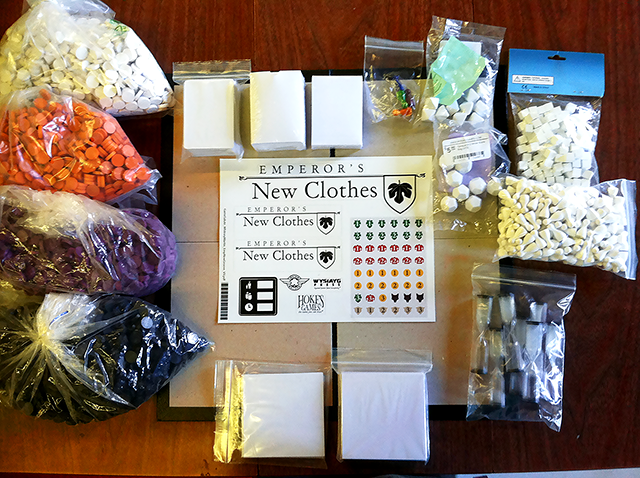
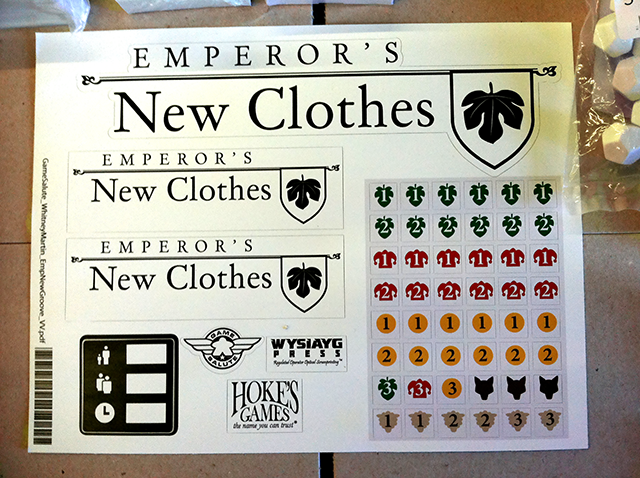
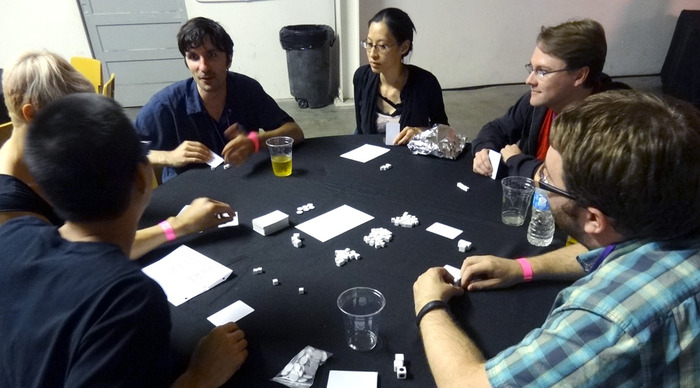
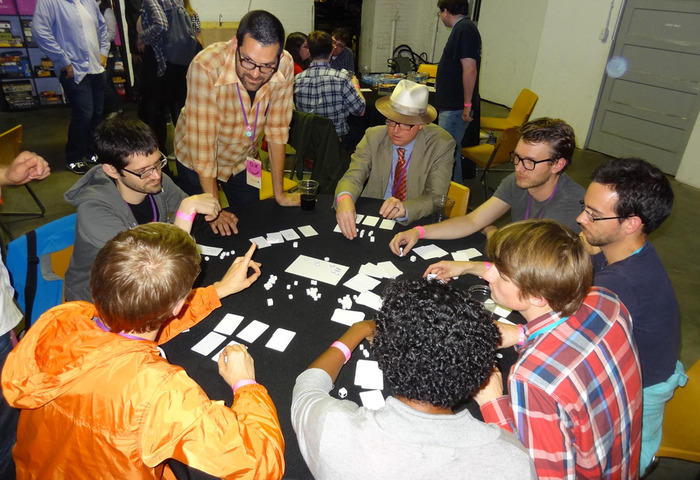
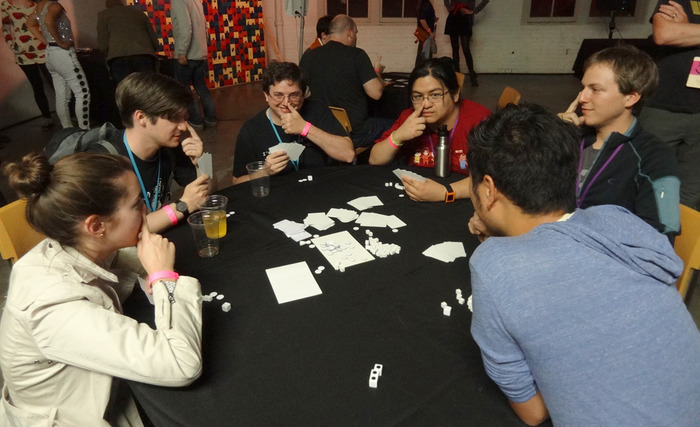


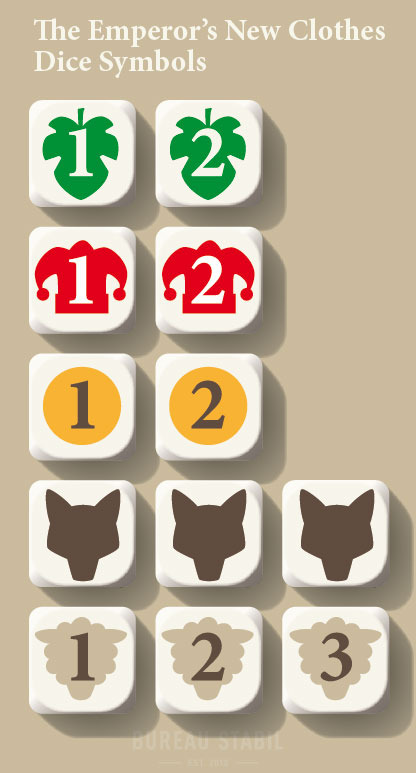


 On top of that, he's also been developing an actual RPG as well! So James has some experience in combining his illustrations and game design, skills that are also useful in a project like Emperor's New Clothes. Although Emperor's New Clothes is designed for older players, James' illustrations make me want to do a kid-friendly version, too. Well, maybe that can be my next project after I recover from this one.


 I loved the non-plussed expressions so many of his characters have, and I think you'll agree we put that to great use in our game. Sure, the Emperor is naked and he's been humiliated in front of all of his subjects, but the parade continues on. You can see more of Avery's work at his website AveryMonsen.com.
